The Problem with “Montessori” in the Name
In Poland, any preschool can add “Montessori” to its name. There are no regulations. There’s no oversight. The result?
A preschool with colorful plastic toys, TV programs for children, and candy rewards for good behavior can call itself “Montessori.”
How do you distinguish authentic Montessori from a marketing gimmick?
Before You Start Looking: What to Expect?
Authentic Montessori is:
- Prepared environment - special materials, low height, order
- Work Cycle - 2-3 hours of uninterrupted activity
- Mixed-age groups - ages 3-6 together
- Qualified teachers - AMI or AMS certificate
- Observation instead of evaluation - no stars, stickers, rankings
- Freedom of choice - the child decides what to work on
Authentic Montessori is NOT:
- Expensive wooden toys in colorful chaos
- 45-minute “lessons” with breaks
- Single age group (all 4-year-olds)
- Rewards and punishments
- “Montessori time” as one of many activities
Open House Checklist
1. PHYSICAL ENVIRONMENT
✅ Look for:
- Low shelves (child can reach independently)
- Materials arranged from simple to complex (left → right)
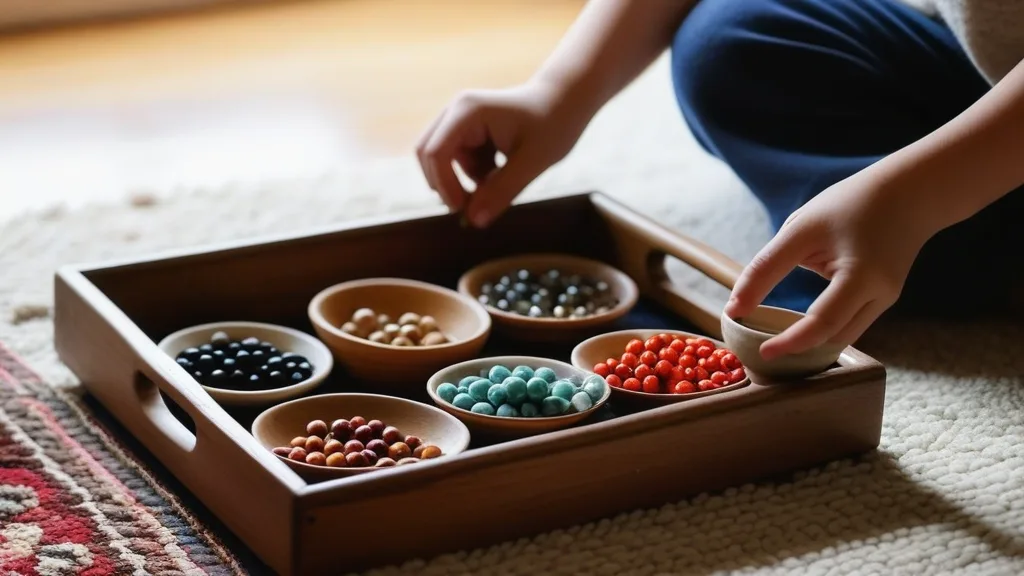
- Natural materials (wood, metal, glass, ceramic)
- Each material in a single copy
- Plants that children water
- Real tools (pitchers for pouring, brushes)
- Rugs for individual work
- Peace/quiet corner
🚩 Red flags:
- Plastic, bright toys
- TV/tablet in the classroom
- “Identical” art projects (templates)
- Decorations at adult height
- Chaos, clutter, excess stimuli
2. DAILY STRUCTURE
✅ Look for:
- Work Cycle 2-3h without interruption (this is crucial!)
- Flexible breakfast (children eat when hungry)
- Outdoor time daily
- Quiet/rest time (not forced naps for everyone)
Example schedule of authentic Montessori:
8:00-8:30   Arrival, settling in
8:30-11:30  WORK CYCLE (3 hours!)
11:30-12:00 Circle time (songs, conversations)
12:00-12:45 Lunch
12:45-14:30 Rest/quiet/quiet work
14:30-15:30 Outdoor time
15:30-16:00 Snack, pickup
🚩 Red flags:
- “Lessons” of 30-45 minutes
- Forced “play time” for everyone together
- Rigid schedule without flexibility
- “Montessori from 9 to 11, then regular activities”
3. TEACHERS
✅ Ask about:
- AMI or AMS certificate (international standards)
- Where did they complete their training? (it takes 1-2 years!)
- How long have they been working with the Montessori method?
- Adult-to-child ratio (ideally 1:10-12)
Recognized certifying organizations:
- AMI (Association Montessori Internationale) - founded by Maria Montessori
- AMS (American Montessori Society)
- Polish Montessori Association (affiliated with AMI)
🚩 Red flags:
- “Online course” or “weekend training”
- Vague answer to the question about certification
- Teacher who “doesn’t believe in some Montessori elements”
4. OBSERVATION (if possible)
Ask for the opportunity to observe a regular day (not a show!).
✅ Look for:
- Children choose activities themselves
- Concentration - children work focused
- Mixed ages - older help younger
- Teacher’s quiet voice (doesn’t shout across the room)
- Teacher observes, doesn’t “lead”
- Children return materials to their place
🚩 Red flags:
- Teacher at the board, children at desks
- All children doing the same thing at the same time
- Loud, chaotic, running
- “Bravo!”, stickers, stars for behavior
5. QUESTIONS TO ASK
About the method:
- “What does a typical ‘work cycle’ look like?”
- “What happens when a child doesn’t want to work with any material?”
- “How do you handle conflicts between children?”
- “Are there rewards and punishments?”
- “How do you communicate progress to parents?” (not grades!)
About practice:
- “Can I see the daily schedule?”
- “How long is the uninterrupted work cycle?”
- “What teaching certifications do you have?”
- “How many children are in a group? What’s the adult ratio?”
- “Are groups mixed-age?”
About adaptation:
- “What does the adaptation period look like?”
- “Can a parent be present during the first days?”
- “How do you help a child who cries at separation?“
6. TUITION AND FINANCES
In Poland, authentic Montessori costs more than standard preschool (materials, teacher training, smaller groups).
Approximate prices (2025/2026):
- Large cities: 2000-4000 PLN/month
- Smaller cities: 1500-2500 PLN/month
- Public preschools with Montessori elements: 500-1000 PLN
Ask about:
- What does tuition include? (meals, additional activities)
- Is there an enrollment fee?
- Are there sibling discounts?
- What about illness/absence?
Differences between “Montessori-inspired” and Authentic Montessori
| Aspect | ”Montessori-inspired” | Authentic Montessori |
|---|---|---|
| Materials | Some wooden toys | Complete set of Montessori materials |
| Work cycle | 30-60 minutes | 2-3 hours |
| Groups | Single-age | Mixed (3-6 years) |
| Teachers | Short courses | AMI/AMS certificate |
| Assessment | Often traditional | Observation, no grades |
| Structure | Montessori + “regular” activities | Full Montessori environment |
“Montessori-inspired” is not bad - it can be a great option if there’s no authentic Montessori nearby. Just be aware of the difference.
Where to Look for Preschools?
Databases and directories:
- Polish Montessori Association (montessori-psm.pl) - list of affiliated institutions
- Montessori Europe - map of institutions in Europe
- Google Maps - search “Montessori preschool” + your city
Social media:
- Facebook groups (e.g., “Montessori in Poland”)
- Instagram - follow preschools, see daily life
Recommendations:
- Friends who send their children
- Parent groups in your area
After Choosing: Red Flags During the Year
Even after careful selection, observe:
🚩 Warning signs:
- Child talks about “punishment chair” or “gold stars”
- Brings home identical art projects as other children
- Talks about “lessons” and “tasks”
- Doesn’t know what they worked on today (“I don’t remember” ≠ “we played tag”)
✅ Good signs:
- Talks in detail about specific materials
- Shows how something is done (knowledge transfer)
- Talks about helping younger ones/learning from older ones
- Happily returns to preschool
Alternatives When There’s No Montessori Nearby
Option 1: Montessori at home + standard preschool
You can apply many principles at home. Preschool can be “good enough.”
Option 2: Preschool with Montessori elements
Not “pure,” but better than nothing. Ask about specific elements.
Option 3: Forest/outdoor preschool
Different philosophy than Montessori, but similar values: autonomy, nature, movement.
Option 4: Wait for Montessori school
If there’s a Montessori elementary school in your area, a child can enter from any preschool.
Summary
Choosing a preschool is an important decision - but not final. Your child will spend 2-3 years there. You can continue Montessori at home, regardless of where they attend.
The most important question: Does this place respect the child, give them autonomy and space to develop at their own pace?
If so - whether it has an AMI certificate or not - it will probably be good for your child.
This article was created based on the standards of the Association Montessori Internationale and the experiences of Polish parents searching for Montessori institutions.
Read also
- After-School Restraint Collapse
- ChatGPT for Parents: How to Use AI Wisely
- End of Tantrums: Understanding and Managing Meltdowns
Frequently Asked Questions
What is the single most important thing to look for when visiting a Montessori preschool?
Look for an uninterrupted work cycle of at least 2-3 hours. This is the hallmark of authentic Montessori practice and the element most often missing in “Montessori-inspired” settings. If the schedule is broken into short 30-45 minute blocks with forced transitions, the core benefit of deep concentration is lost.
Is a “Montessori-inspired” preschool still worth choosing over a regular one?
Yes, a Montessori-inspired preschool can still be a very good option, especially if there is no fully accredited program nearby. Even partial elements like mixed-age groups, child-led activities, and respect for the child’s pace offer real developmental benefits compared to a purely traditional setting.
Can my child switch from a regular preschool to a Montessori school later without problems?
Absolutely. Children adapt remarkably well, and Montessori elementary schools accept children from all preschool backgrounds. There may be a short adjustment period as your child learns the routines and materials, but most children settle in within a few weeks and thrive in the new environment.
Author
Dzieckologia Team
Like this topic?
🎯 Browse all "Methods in practice" articles