TL;DR
- You can’t recreate a Montessori school at home — and that’s not the point. The prepared environment, the mixed-age group, the trained guide and the three-hour work cycle are things an apartment can’t replace.
- Principles travel better than equipment. Independence, observing instead of correcting, real work, freedom within limits, intrinsic motivation — these work in an eight-year-old’s home just as they do in a classroom.
- A home prepared for a school-age child isn’t shelves of wooden materials. It’s a place where the child manages their own school things, daily plan and morning routine — without an adult standing over them.
- With homework, your role ends sooner than you think. Supporting your child’s autonomy is linked to better motivation and self-regulation; doing the homework for them is not.
- The biggest risk is the “second school.” An afternoon filled with worksheets and tutoring destroys exactly what Montessori tries to protect: intrinsic curiosity. Boredom, free play and unscheduled time are part of the plan too.
Your child goes to a regular, public school. Desks, a bell, a class of twenty-something kids, textbooks, grades. And you’re reading about Montessori and feeling a mix of things: a little admiration, a little regret that “it didn’t work out,” and a question — can any of this be brought home, now that the child is already inside the system?
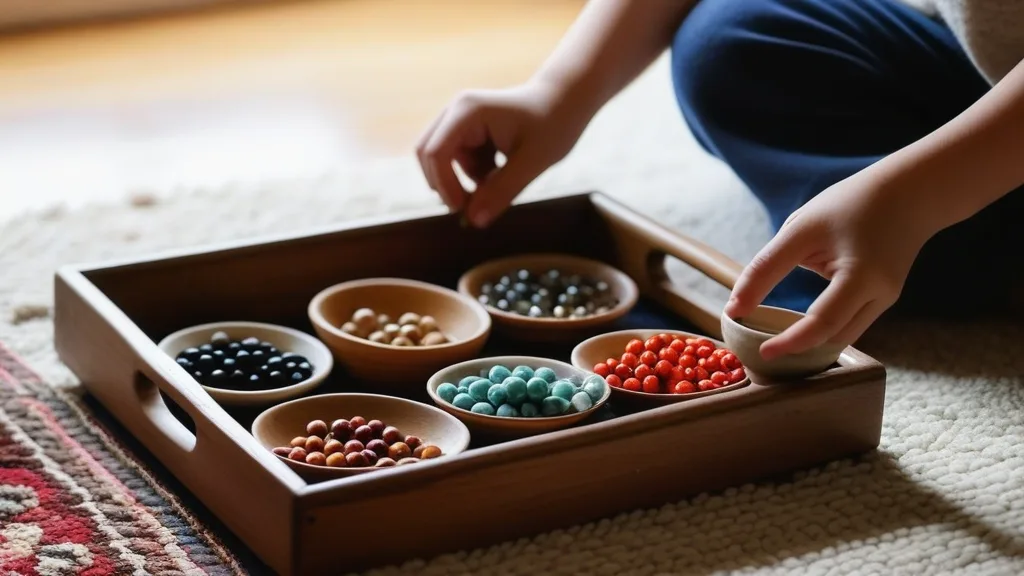
It can. But not the way most guides suggest. “Montessori at home” usually shows up as aesthetic shelves, wooden trays and kits to buy. That’s the least important part — and the one that has the least to do with a public-school student. First it’s worth being honest about what can’t be done. Only then about what actually works.
What You Can’t Recreate at Home — and That’s Fine
Let’s start with honesty, because without it the rest turns into pressure.
The prepared environment. A Montessori classroom is years of design: materials arranged by difficulty, everything accessible, every object with its place and purpose. A living room where a family’s normal life unfolds will never be that — and trying to turn it into a classroom ends in frustration for everyone.
The mixed-age group. In a Montessori class a six-year-old learns by watching an eight-year-old, and by teaching a younger child consolidates their own knowledge. One child (or two siblings) at home can’t recreate that.
The trained guide. A Montessori teacher goes through long training in observing the child and presenting material at the right moment. You’re a parent, not a guide — and that’s okay. Your role is a different one.
The uninterrupted work cycle. The three-hour block in which a child chooses and deepens their own tasks is the heart of the method. An after-school afternoon — tired, hungry, with homework in the background — isn’t that and won’t be.
And something important: the research on Montessori’s effectiveness is about Montessori schools, not “Montessori at home.” A 2023 systematic review (Randolph et al., Campbell Systematic Reviews) found consistent positive effects across all nine measured areas — academic, social-emotional and attitudinal — but it measured children attending Montessori schools. So did a controlled trial using lottery-based random assignment (Lillard et al., Frontiers in Psychology 2017). No one has shown that a “Montessori corner in the bedroom” alongside public school produces those effects — because it’s simply a different thing.
The good news: what does carry over to the home isn’t equipment. It’s principles. And those don’t require a classroom or a certificate.
What Travels: Principles, Not Equipment
Maria Montessori observed how children develop, and only from that derived her tools. The tools are tied to the classroom. The observations are not. Here are the ones that work in a school-age child’s home.
Independence as the default mode. Montessori’s guiding question is: “can the child do this themselves?” In the school years the list is long: making a sandwich, packing the backpack according to the timetable, setting an alarm, laying out tomorrow’s clothes, managing their own supply corner. Every thing you do for a nine-year-old “because it’s faster” is one competence less.
Observation instead of correction. The hardest and most important one. Instead of stepping in (“not like that,” “here, let me show you”), look a moment longer. A child who notices for themselves that the backpack is packed wrong learns more than a child whose backpack gets repacked for them.
Real work matters in the school years too. “Practical life” doesn’t end at preschool. An eight-year-old who cooks part of dinner, handles the laundry of their own things or cares for a plant gets something a worksheet can’t give: a sense of real contribution and agency.
Freedom within limits. Montessori isn’t “do whatever you want.” It’s a clear, small number of boundaries — and full freedom within them. At home: the child doesn’t decide whether to do the homework, but does decide when and where within the afternoon.
Intrinsic motivation instead of a reward system. School brings grades, stars, sometimes competition. Home doesn’t have to duplicate that. Supporting a child’s autonomy — offering choices, explaining reasons, acknowledging their perspective — is linked to stronger intrinsic motivation and better self-regulation than control and rewards (Grolnick et al., self-determination theory).
A Home Prepared for a Student, Not a Second Classroom
A “prepared environment” for a public-school student doesn’t mean Montessori-classroom-style shelves. It means a home where the child can function independently — functionally, not aesthetically.
- A fixed place for school things. One point they take everything from in the morning and everything returns to in the afternoon. You don’t remember where the PE kit is — the system does.
- A visible daily and weekly plan. The timetable, fixed afternoon points, deadlines — somewhere the child checks themselves. The goal: the child asks the calendar, not you.
- Everyday things within reach. Glasses, water, a healthy snack, supplies at child height. Everything they have to ask for is one more situation of dependence.
- A place to work — and a place to do nothing. A quiet corner for homework. And just as important: a space where there is no task at all.
That’s it. No buying “Montessori materials.” A prepared home is a home where the adult is less needed to run daily life — not a home that looks like a catalogue.
Homework: Where Your Role Ends
Homework is the point where most parents lose the Montessori principle — they sit down beside the child and slowly start doing it for them.
It’s worth knowing the context. In the younger grades the relationship between the amount of homework and academic results is close to zero — the academic benefit rises clearly only in the older grades (Cooper et al., research synthesis 1987–2003). That doesn’t mean “ignore homework.” It means: in the first school years its real value isn’t the knowledge itself — it’s building the habit of independent work. And a habit can’t be built by doing something for someone.
The Montessori approach to homework:
- The child decides when and where — within the afternoon. You hold the frame, you don’t steer inside it.
- You sit nearby, not over them. Available, but not monitoring. “I’m in the kitchen, call me if you get stuck” works better than a presence that controls every line.
- Help is a question, not an answer. “Where do you want to start?”, “What do you already know?”, “Where exactly did you get stuck?” — instead of handing over the solution.
- Unfinished or done-with-mistakes goes back to school as it is. It’s hard, but it’s feedback for the teacher — and for the child. Homework done by the parent tells no one the truth.
Your role ends at preparing the conditions and being within reach. The rest belongs to the child — including the consequences.
The “Second School” Trap
This is the most common mistake of engaged parents — and exactly the one Montessori warns against most strongly.
The logic seems reasonable: if regular school “isn’t Montessori,” then home should make up for it. So after lessons come worksheets, extra exercises, tutoring “just in case,” activities filling every afternoon. Home turns into a second shift.
The problem: this destroys exactly what the method tries to protect. Intrinsic curiosity — the engine of all of Montessori — fades under pressure and an excess of externally imposed tasks. A child whose every hour is scheduled has no time to develop their own interests, because they have no time to be bored.
A Montessori home alongside public school often does less, not more:
- It protects unscheduled time — boredom is the start of one’s own play, not a gap to fill.
- It allows free, child-led play past the age of eight too.
- It says “no” to some extracurriculars — not out of laziness, but to leave space.
- It treats the afternoon as time for recovery and real family life, not an extension of lessons.
If you have to choose between adding one more exercise and leaving the child a free afternoon — from a Montessori perspective the free afternoon wins.
A Neurodivergent Child: A Brief Note
Everything above applies to every child. If your child has ADHD, is on the autism spectrum or is highly sensitive, two things are worth underlining.
First — the “second school” trap is more dangerous for them. A child who spent the whole day regulating themselves in a sensorily difficult environment needs release on returning home, not more tasks. A free, predictable afternoon isn’t a luxury for them — it’s a condition.
Second — independence is built here more slowly and more step by step, but the direction is the same. Smaller stages, more visible prompts (lists, picture plans), more time — but still toward “can the child do this themselves,” not toward doing it for them.
FAQ
Is there any point starting Montessori at home if the child is already in public school? Yes — because what you bring home is principles, not a teaching method. Independence, supporting autonomy and protecting intrinsic motivation work regardless of which school the child attends and how old they are.
Do I have to buy “Montessori materials”? No. Montessori materials are designed for the classroom and for a specific teaching cycle. In a public-school student’s home what matters most are the things that cost nothing: accessibility, independence, observation instead of correction, free afternoons.
Should I help with homework? Yes, but differently than most parents understand “help.” Prepare the conditions, be within reach, ask questions instead of handing over answers. Don’t do the homework for the child and don’t correct everything to perfection — unfinished work is information for the teacher.
My child doesn’t want to be independent, they’d rather I do it for them. What now? That’s normal if for years things were done for them “because it’s faster.” Bringing independence back is gradual: one thing at a time, accepting that at first it will be slower and less precise. It’s about the direction, not an instant jump.
Are tutoring and extracurriculars at odds with Montessori? Not by definition — what’s at odds is the situation where they fill the whole afternoon. One or two activities the child chose and enjoys are a different thing than a schedule without a single free hour. The question isn’t “how much to add,” it’s “how much free time is left.”
You want the best of Montessori for your child — and at the same time your child goes to a regular school. Those two things don’t exclude each other. At Dzieckologia we write about child development ages 3-10 without dogma — we compare methods and show what actually works from them in real homes. Visit the Methods in Practice pillar if you want to see how Montessori differs from Waldorf and Reggio — and what to choose for your child.
Author
Dzieckologia Team
Tags:
Like this topic?
🎯 Browse all "Methods in practice" articles