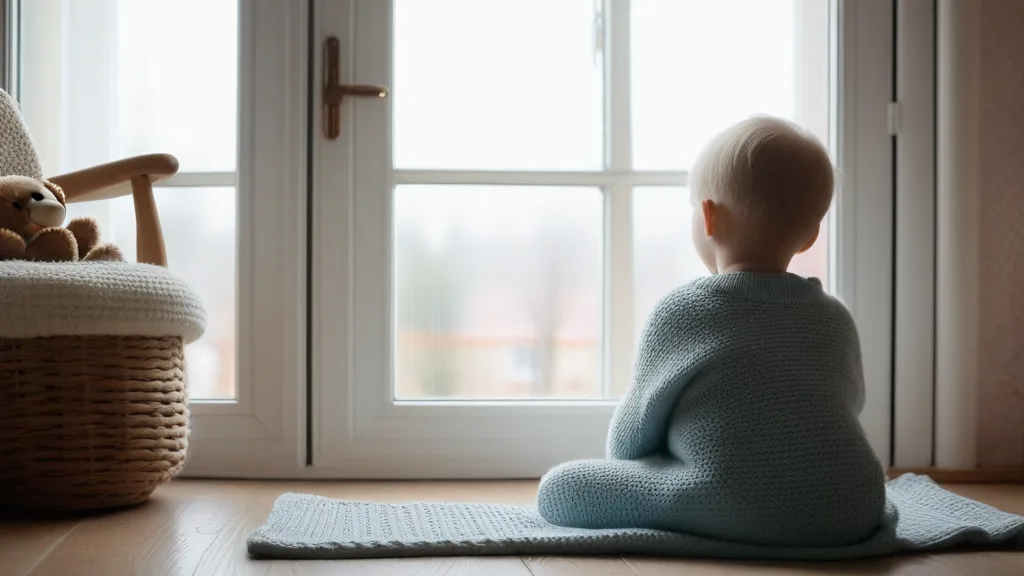
It’s 5:47 PM. Your 7-year-old has been holding it together at school all day. Now he’s screaming because his sister moved his Lego. You hear yourself say “Go to your room and calm down.” He goes — and slams the door. Five minutes later it’s worse, not better.
Time-out doesn’t work for ADHD kids. The neuroscience explains why — and points to a better alternative.
TL;DR
When an ADHD child melts down, their prefrontal cortex (the “calm down” part of the brain) is offline. Sending them away to “calm down alone” makes things worse, because they literally cannot self-regulate yet. The Montessori calm-down corner — done right — gives them a tool to co-regulate with you, then eventually solo. Here’s the 8-essential setup, age-by-age scripts, and common mistakes that derail it.
Why time-out fails ADHD kids (the neuroscience)
Time-out fails ADHD kids because during a meltdown their prefrontal cortex — the brain’s own “calm down” center — is offline; sending them away to “calm down alone” only deepens the dysregulation instead of reducing it.
When your child explodes, three things happen in their brain at once:
- Limbic system floods — the emotion center fires at full power
- Prefrontal cortex offline — the planning/control center literally cannot access logical thought
- Cortisol spikes — stress hormones cascade for 20-90 minutes
This is true for all kids. For ADHD kids it’s worse because:
- Delayed prefrontal development — ADHD brains are 2-3 years behind in executive function (Shaw et al., 2007). What “calm down” requires of a 7-year-old is what their brain handles like a 4-5-year-old.
- Lower cortisol regulation — research suggests neurodivergent kids take longer to recover from stress activation.
- Rejection sensitivity — being sent away when overwhelmed reads as abandonment, escalating shame.
So when you say “go to your room and calm down”:
- The child’s brain hears: “you’re too much, I don’t want you near me”
- The dysregulation increases (now there’s shame on top of the original trigger)
- Without your nervous system to co-regulate against, recovery takes 2-4× longer
This is not a parenting failure. It’s a misunderstanding of brain science. Time-out was designed for neurotypical 1990s kids — and even for them it’s questionable.
Calm-down corner ≠ punishment
The Montessori calm-down corner is the opposite of time-out. It’s:
- Chosen, not imposed — child goes when they need it (or you invite, never force)
- Co-regulated, not solo — for kids under 8, you usually go too
- Sensory-rich — tools that calm the nervous system, not just walls
- Practiced calm, not in crisis — introduced and used during regulated moments first
The framework comes from co-regulation theory (Tronick, Schore): children regulate by being regulated. Your calm nervous system is the “external regulator” their brain borrows from. The corner is the physical space where this happens.
For more on co-regulation in everyday life, see Emotional Intelligence Ages 3-7 — daily rituals that build the foundation a calm-down corner depends on.
8 essentials for an ADHD calm-down corner
Don’t buy a Pinterest-perfect setup. Start with these eight functional pieces:
1. Defined boundary (small space)
Use a soft fabric tent, a corner with cushions, an unused closet with the door open. Size: just big enough for child + you. Smaller spaces are more regulating (proprioceptive input from walls).
2. Soft, dim lighting
LED ceiling lights are the enemy. Use a warm-bulb table lamp, fairy lights, or a salt lamp. The light cue signals “this is a different kind of space.”
3. Sensory tools (proprioceptive)
- Weighted lap pad (2-5 kg depending on child’s weight)
- Body sock or compression vest
- Stress ball, putty, or therapy dough
These provide deep pressure input — the most regulating sensory input for an overwhelmed nervous system.
4. Sensory tools (oral/chewing)
- Chewlry (chewable jewelry/necklaces) for older kids
- A bottle of cold water with a straw
- Crunchy snacks (pretzels, carrot sticks)
Chewing and sucking activate the parasympathetic nervous system — the “rest and digest” mode opposite of fight-or-flight.
5. Visual emotion chart
A simple poster: angry, frustrated, sad, scared, lonely, overwhelmed (with simple faces). Pointing at the feeling externalizes it. Don’t expect verbal explanation in crisis — pointing is enough.
6. Breathing prompt cards
3-5 cards with simple breathing patterns:
- Star breathing (trace a star, breathe in on each point)
- Bumblebee breath (hum on exhale)
- 4-7-8 breath (in 4, hold 7, out 8)
Visual prompts work when verbal instructions don’t (prefrontal cortex offline, remember).
7. Comfort item
A specific stuffed animal or blanket that lives only in the corner. Keeps the association: this place = comfort, not punishment.
8. Headphones (noise-cancelling)
Optional but powerful. For sensory-sensitive ADHD kids, removing auditory input is often the fastest regulation tool.
Reality check: You don’t need all 8 to start. Start with 3 (boundary, weighted lap pad, breathing cards). Add as needed based on what your child gravitates toward.
Step by step: introducing it without a fight
Most parents make the same mistake: they set up the corner, then offer it during the next meltdown. The child rejects it. They write off the whole approach.
Here’s what works:
Step 1: Build it together (calm moment)
On a Saturday morning, with the child, set up the corner. Let them pick the location, the comfort item, the colors of the breathing cards. Make it theirs.
Step 2: Practice during regulation
For two weeks, do 5 minutes daily in the corner together — read a book, do breathing exercises, just sit. Build the association: this is a good place.
Step 3: Model using it yourself
When YOU are stressed (5 PM, dinner not made, work email anxiety), say: “Mom needs the calm corner. Be back in 5 minutes.” Use it. Come out calmer. Demonstrate.
Step 4: Offer (don’t force) during pre-crisis
When you see the early signs — voice raising, shoulders tight, eyes flickering — offer once: “Want to take this to the calm corner?” If they say no, drop it. Forcing now = punishment dynamic.
Step 5: Co-regulate during crisis
When meltdown lands, don’t talk. Sit nearby (not pushing). Match their breathing, then slowly slow yours. Their nervous system will follow yours within 5-15 minutes.
For school-age kids, a portable kit version works for car/school: a small bag with chewlry, fidget, and emotion card.
Common mistakes that derail it
The most common mistake is turning the corner into a punishment or expecting solo use too early — both strip the tool of its regulating function.
Using it as a threat
“If you keep this up you’re going to the calm corner.” Now it’s punishment. Start over with rebranding (give it a new name like “the cozy spot”) and rebuild the positive association.
Expecting a 3-year-old to use it solo
Co-regulation is required for kids under 7-8 (and many ADHD kids past that). If you expect them to “go calm down alone,” you’re back to time-out. Sit with them.
Rigid time limits
“Five minutes in the corner” is time-out logic. Calm-down takes 20-90 minutes for a flooded brain. Your job is to be available, not to enforce duration.
Removing it after good behavior
The corner is not earned or removed based on behavior. It’s a permanent regulation tool, like a toothbrush.
Skipping the modeling step
Kids do what we do, not what we say. If you don’t use the corner yourself when stressed, the child reads it as “this is for broken kids.”
From corner to coping skills (4-week progression)
The corner is scaffolding, not the goal. Long-term, you want internalized self-regulation. Progression:
Week 1-2: Corner with parent
- All meltdowns: parent + child in corner together
- Practice: 5 min daily during calm
Week 3-4: Corner with parent nearby
- Child goes; parent stays in same room (within sight)
- Parent narrates: “I see you breathing. I’m right here.”
Week 5-8: Corner solo (parent available)
- Child goes; parent says “I’ll be in the kitchen, come find me when ready”
- Reentry ritual: hug, water, “what helped you calm down?”
Week 9+: Portable kit
- Same tools in a small bag for car, school, grandma’s house
- Child can request “I need my kit”
This timeline assumes typical progress for an ADHD child age 5-8. Younger kids and severely dysregulated kids take longer. Don’t push the timeline.
For the foundational sensory space concept, see The Quiet Corner — broader principles that apply beyond ADHD. And for the full Montessori-ADHD framework, Is Montessori Good for ADHD? covers the wider context.
Sources
- Shaw P., Eckstrand K., Sharp W. et al., PNAS, 2007 — neuroimaging study showing ADHD children’s cortical maturation is delayed roughly 2-3 years relative to peers, especially in prefrontal regions responsible for control and planning: pubmed.ncbi.nlm.nih.gov/18024590
- Tronick E., The Neurobehavioral and Social-Emotional Development of Infants and Children, W.W. Norton, 2007 — theoretical framework for co-regulation: children learn to regulate emotion by being regulated by a caregiver’s calm presence.
- Schore A.N., Affect Regulation and the Origin of the Self, Lawrence Erlbaum Associates, 1994 — neurobiological basis for co-regulation and the caregiver’s nervous system acting as an “external regulator” for the child.
Want more practical, science-based parenting?
We write about neurodiversity without dogma — for parents who want what actually works.
Author
Dzieckologia Team
Tags:
Like this topic?
💛 Browse all "Emotions" articles