You’re scrolling Instagram. You see a perfectly styled Montessori shelf: wooden blocks for $80, a pink tower for $120, rainbow threading beads in a linen basket. Everything in beige-and-white tones. Caption below: “Montessori doesn’t have to be expensive!”
Really?
Now imagine another child. They have a cardboard box from a washing machine, 20 buttons, sticks from the park, and a toilet paper roll. They’re building a “spaceship,” sorting buttons by size, poking sticks through holes in the cardboard, and saying: “These are antennas because I need to talk to Mars.”
Which child learned more?
Research into loose parts play gives a consistent answer: loose, unstructured materials spontaneously trigger exploratory, “STEM-like” behaviors in children — testing, classifying, constructing — often more strongly than ready-made kits. A systematic review (Gibson et al., American Journal of Play, 2017) links this kind of play to better problem-solving, creativity and divergent thinking.
This article is for parents who want to give their children MORE for LESS. Zero ideology, pure practicality.
What Is Loose Parts Play? (And Why It’s Not Just a Mess)
The term “loose parts” was coined by architect Simon Nicholson in 1971. His theory: the more moveable, undefined elements in an environment, the more creativity, discovery, and learning.
Loose parts are materials that:
- Have no single “correct” use
- Can be moved, combined, stacked, taken apart
- Are usually free or very cheap
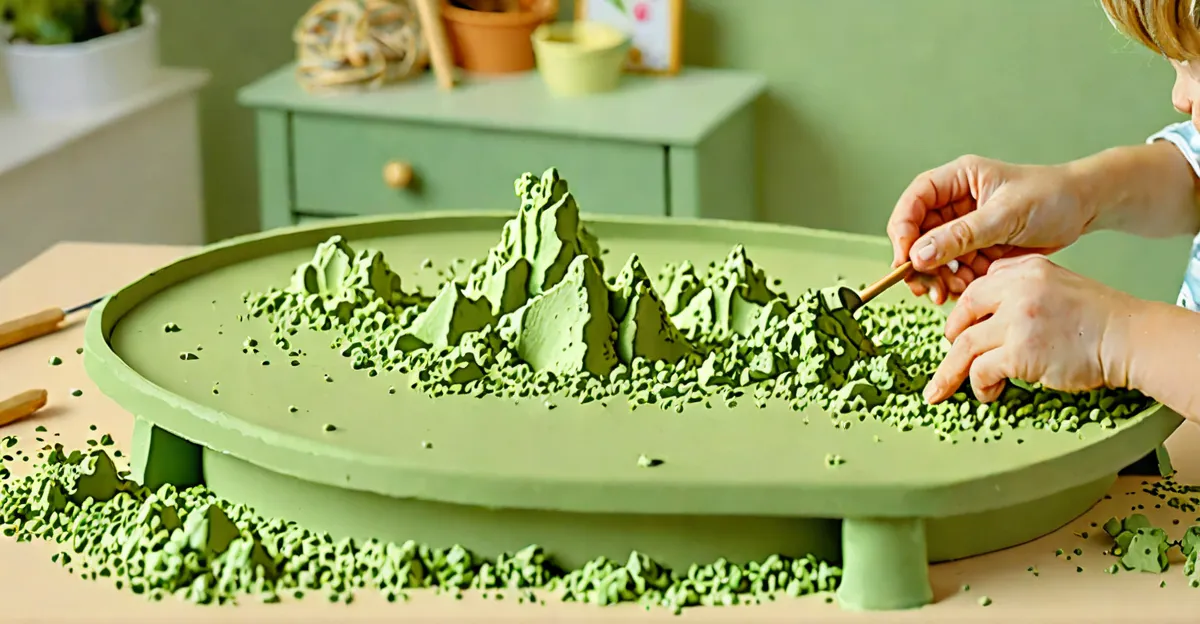
Examples: stones, sticks, shells, buttons, corks, pinecones, fabric scraps, toilet paper rolls, wooden blocks, clothespins, bottle caps, cardboard, sand, water.
This isn’t a mess. It’s a laboratory.
Why Does This Work Better Than Ready-Made Toys? (What the research says)
A ready-made toy imposes one script; loose parts leave the decision to the child — and that open-endedness is exactly what drives the learning. Researchers observe that with materials that have no predetermined purpose, children enter exploratory behaviors on their own, without adult instruction.
What researchers observe
Without any adult instruction, children with loose parts naturally:
- Test hypotheses (“what happens if I put this stone on top of that one?”)
- Classify and sort (by color, size, shape)
- Build structures and solve engineering problems
- Experiment with balance, gravity, proportions
What the research review shows
A systematic review of the literature (Gibson et al., 2017) associates loose parts play with:
- Higher divergent thinking (the ability to generate multiple solutions)
- Better problem-solving
- Greater creativity than with single-purpose toys
- Longer engagement time – children play LONGER than with ready-made sets
Why Expensive Toys Lose
A ready-made toy tells the child: “Do it this way.” Loose parts say: “Do whatever you want.”
An educational tablet costing $100 has 3 game modes. A washing machine box has infinite modes – it’s a house, a ship, a tunnel, a shop, a bed for teddy, a rocket, a garage, and whatever else a 3-year-old invents.
Reddit (r/ScienceBasedParenting): “We stopped buying ‘educational’ toys and replaced them with boxes, sticks, and stones. Kids play 3x longer and fight 3x less.”
The Problem with “Instagram Montessori”
Let’s say it plainly: Montessori is a philosophy, not a product catalog.
Maria Montessori worked with children from poor neighborhoods in Rome. She used what she had – pots, spoons, fabrics, grains. Her didactic materials (pink tower, red rods) are TEACHER tools in a CLASSROOM – not a mandatory home kit.
“Instagram Montessori” has turned a philosophy of independence into an aesthetic of consumption:
- “You need this specific IKEA shelf”
- “Buy this wooden fruit set”
- “Without the pink tower, it’s not Montessori”
This is false. Montessori at home means:
- Child pours water on their own (from ANY pitcher)
- Child sorts (ANYTHING – socks, beans, buttons)
- Child cleans up after themselves (with ANYTHING – a cloth, a thrift-store broom)
Loose parts play is MORE Montessori than an expensive Instagram set. Because it’s about PROCESS, not PRODUCT.
Waldorf + Loose Parts: Imagination from Nature
Waldorf has always loved undefined materials – unpainted wooden blocks, silk scarves, beeswax, stones. Rudolf Steiner believed that the less detailed a toy, the more the child’s imagination works.
A wooden block can be a phone, a sandwich, a car, and a baby in a cradle – all in one afternoon.
A plastic phone will always just be a phone.
This isn’t sentimental nostalgia. Play research confirms: children playing with undefined materials show higher levels of symbolic play – which is a key indicator of cognitive and language development.
Reggio + Loose Parts: “100 Languages” in Action
Reggio Emilia and loose parts are a perfect match. Malaguzzi said children have “100 languages” – 100 ways to express thinking. Loose parts ARE those languages:
- Stones in a row = a story
- Sticks in sand = a drawing
- Buttons on paper = a map
- Fabric over chairs = a house
In Reggio preschools, provocations (invitations to play) often consist entirely of loose parts: a bowl of water, stones, leaves, a magnifying glass. The teacher observes and documents. The child leads.
10 Loose Parts Ideas from Home and Recycling
Kitchen (Cost: $0)
- Beans, rice, pasta – for sorting, pouring, counting. Montessori version: spoon + two cups = fine motor practice.
- Pots, lids, wooden spoons – music, towers, “cooking.” Waldorf: rhythmic banging is kitchen eurythmy.
- Bottle caps – color sorting, tower building, “money” for playing shop.
Bathroom and Drawers (Cost: $0)
- Toilet paper rolls – tunnels, towers, binoculars, “rockets.” The world’s best engineering toy.
- Sponges cut into pieces – building, squeezing water, “blocks” for wet play.
- Clothespins – fine motor skills, sorting, building structures on cardboard.
Garden and Park (Cost: $0)
- Sticks – letters, building, “swords” (risky play!), frames for leaf pictures.
- Stones – sorting, painting, balance towers, “food” in pretend play.
- Leaves, chestnuts, acorns – collections, ground mandalas, counting, learning colors.
Recycling (Cost: $0)
- Cardboard boxes – houses, cars, robots, a “TV” with a cut-out screen and puppets.
How to Organize Loose Parts at Home (Without Chaos)
Montessori system:
- Each type of material in a separate container (basket for stones, jar for buttons, box for sticks)
- Shelf at child height – child takes and returns independently
- Rotate every 1–2 weeks: hide half, bring out “new old” ones
Waldorf system:
- “Nature treasure” basket by the door – after every walk, add new finds
- Silk scarves (or regular scarves) in a basket – for building, dress-up, “landscapes”
Reggio system:
- “Provocation station” on the table: 3–5 materials + a tool (magnifying glass, brush, water container)
- Change every 3–4 days – observe what attracts the child
Loose Parts + Neurodiversity: Why This Is Gold
For ADHD
- Novelty without buying: just change the combination of materials – new play every day
- Movement woven into play: carrying, building, knocking down = proprioception
- No “wrong” answers: there’s no “incorrect” in loose parts – less frustration
- Short cycles: child can build for 5 minutes, destroy, start over – that’s OK
For Autism
- Sorting and ordering: stones by size, buttons by color – calming, repetitive
- Predictable materials: the same stones, same buttons – safe, familiar
- Sensory input: different textures, temperatures, weights – controlled sensory play
- Hyperfocus is a superpower: child arranging stones for 40 minutes? Perfect.
For High Sensitivity (HSC)
- Natural materials: wood, wool, stones – gentle stimuli vs plastic and LEDs
- Quiet play: loose parts don’t beep, flash, or scream
- Control: child decides their own pace and intensity
From Reddit (r/autism_parenting): “I threw out 80% of plastic toys. My autistic daughter now spends hours sorting stones and buttons. She’s calmer than ever. The SI therapist said: ‘This is exactly what her nervous system needs.’”
Comparison: Loose Parts vs Ready-Made Toys
| Aspect | Loose Parts | Ready-Made Educational Toys |
|---|---|---|
| Cost | $0 (home/recycling/nature) | $15–$150+ |
| Engagement time | Longer (research observations) | Shorter (novelty fades fast) |
| Divergent thinking | High | Low (one “correct” path) |
| STEM behaviors | Spontaneous (observed in research) | Forced by instructions |
| Sensory value | Enormous (varied textures, weights) | Limited (plastic = plastic) |
| For neurodivergent kids | Ideal (control, sorting, no “mistakes”) | Often frustrating (too loud, too fast) |
| Ecology | 100% recycling | Plastic, batteries, packaging |
30 Things from Your Kitchen and Garden – Printable List
Kitchen: beans, rice, pasta, bottle caps, pots, lids, spoons, cups, sieve, funnel, sponges, clothespins, baking paper, aluminum foil, egg cartons.
Garden/park: sticks, stones, leaves, chestnuts, acorns, pinecones, shells, sand, feathers, bark, flower petals.
Recycling: cardboard boxes, rolls, PET bottles (without caps), old newspapers, fabric scraps, buttons, corks.
Junk drawer: old keys, chains, large screws (safe sizes), wooden blocks, string, ribbons.
Want this list as a fridge-ready PDF? Sign up for our newsletter – we’ll send it along with the “Curiosity Card” and checklists from previous articles.
Summary: Buy Less, Observe More
Loose parts play isn’t a “cheap alternative to real toys.” It’s the better option – confirmed by science, practiced by Montessori, Waldorf, and Reggio for decades.
Your child doesn’t need a perfect beige shelf from Instagram. They need a cardboard box, stones, buttons, and a parent who says: “What will you build from this?”
And if someone tells you “that’s not real Montessori” – remind them that Maria Montessori started with handfuls of beans in a poor Roman neighborhood. And geniuses came out of it.
Next article: emotional intelligence at ages 3–7 – 8 simple rituals from Waldorf and Montessori.
Read also
- DIY Sensory Materials: 10 Ideas for Home
- Sensory Play: Why It Matters for Development
- Cleaning with a 4-Year-Old: How to Make Tidying Up Fun
Loose Parts, Concentration, and Executive Function
Parents often wonder: “Is this play actually teaching anything?” The science is clear. Loose parts play engages executive function — the cluster of cognitive skills that predict school success and lifelong self-management. These include planning (what will I build?), cognitive flexibility (my plan failed — let me try differently), impulse control (I won’t take that piece or my tower will fall), and working memory (I hold my design in mind while building).
Concentration deepens naturally during this kind of play without any adult prompting. The reason is that loose parts always sit at just the right difficulty level for a child: easy enough to start, complex enough to stay engaging. Montessori called this state the “polarization of attention” — deep focus that is the foundation of all later learning. A child balancing stones for twenty minutes is training the same concentration they will need for reading and mathematics.
Sensory processing develops too. The texture of a pinecone, the temperature of a metal bottle cap, the weight of a cardboard tube — this is natural stimulation of the tactile and proprioceptive systems that helps children understand their own bodies and the physical world. Children who have regular access to varied textures through screen-free play with natural materials often show calmer, more organized sensory responses in busy environments like classrooms.
Step by step: how to start at home
You can introduce loose parts play in a single afternoon, without buying anything — just gather, sort, and hand it to the child without instructions. The sequence below distills what’s laid out above as the Montessori, Waldorf and Reggio systems.
- Gather materials from three zones. Go through the kitchen, a walk/park and the recycling bin. Pick items that can be moved, combined and stacked: bottle caps, stones, sticks, rolls, buttons, cardboard.
- Sort into separate containers. Each type of material into its own basket or jar. The order of the containers itself invites the child to sort and compare.
- Set them on a shelf at child height. Materials within reach, so the child takes and returns them independently — that independence is the point.
- Offer them without instructions. Put the materials out and don’t explain “how to play” with them. Open-endedness is the point: let the child decide what a stone is.
- Observe and rotate every 1–2 weeks. Note what holds the child’s attention longest, hide half, and after a week bring out the “new old” ones. Rotation refreshes play without spending a cent.
Sources
- Simon Nicholson, Landscape Architecture, 1971 — “How Not to Cheat Children: The Theory of Loose Parts,” the source text for the “loose parts” concept: media.kaboom.org (PDF)
- Gibson J. L., Cornell M., Gill T., American Journal of Play, 2017 — “A Systematic Review of Research into the Impact of Loose Parts Play on Children’s Cognitive, Social and Emotional Development”; a review linking loose parts play to problem-solving, creativity and divergent thinking: journalofplay.org
Author
Dzieckologia Team
Tags:
Like this topic?
🏠 Browse all "Practical life" articles