The Surprising Paradox: Writing Before Reading
In traditional school: we read first, then write.
But in approaches like Montessori education, it’s often the opposite. Children write their first words before they read others’ words.
How is this possible?
The Difference Between Writing and Reading
Writing = Encoding
I have the word “CAT” in my head. I break it down into sounds: C-A-T. I find the letters corresponding to the sounds. I arrange them.
This is analysis - from whole to parts.
Reading = Decoding
I see the letters: C-A-T. I combine the sounds. I recognize the word.
This is synthesis - from parts to whole.
For a child’s brain:
Analysis (breaking down) is EASIER than synthesis (putting together).
That’s why writing can come first.
The Learning Sequence
Stage 1: Phonological Awareness (2-4 years)
Before a child sees a letter, they must hear the sounds.
Sound Games:
“I Spy…” “I spy something that starts with ‘mmm’.” (mommy, moon, milk)
“Guess the Word” “C…A…T. What is it?” (speak slowly, sound by sound)
Rhyming “Cat, bat, rat - what else rhymes with CAT?”
Clapping Syllables “MOM-MY” (clap-clap). “DI-NO-SAUR” (clap-clap-clap).
Why is this so important?
A child who doesn’t hear sounds in words won’t connect them to letters. This is the foundation.
Stage 2: Sandpaper Letters (3-5 years)
In this approach — originally developed in Montessori classrooms — letters aren’t pictures in a book. They’re a tactile experience.
Sandpaper Letters:
- Wooden or cardboard tablet
- Letter cut from sandpaper
- Child traces with finger
DIY at Home:
- Cut letters from sandpaper
- Glue onto cardboard
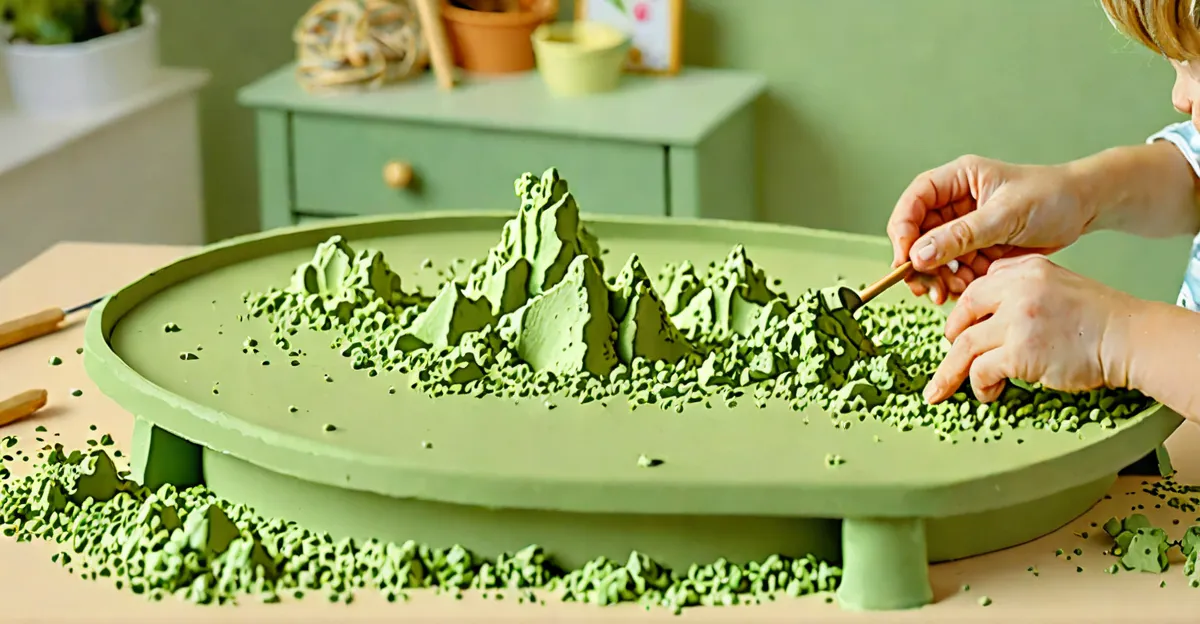
- Or: write with finger in a tray of semolina/sand
Three-Period Lesson:
Step 1: Naming “This is ‘mmm’” (you trace, child observes)
Step 2: Recognition “Show me ‘mmm’” (child points/traces)
Step 3: Recall “What is this?” (you show, child names)
Order of Letters:
NOT: alphabetically (a, b, c…) YES: according to usefulness and ease
Start with: m, a, t, s, c, o, i, r, e, l
Why? Because with these letters you can quickly form first words!
Stage 3: Movable Alphabet (4-5 years)
Printed letters (wooden, plastic, printed) for arranging words.
How it works:
- Child thinks of a word: “mom”
- Hears the sounds: m-o-m
- Looks for the corresponding letters
- Arranges the word
This is writing - without writing!
A 4-year-old’s hand isn’t ready for a pencil, but their mind is ready to create words.
DIY:
- Print letters (large, legible)
- Cut and laminate
- Store in a box divided into vowels/consonants
Stage 4: Writing (4-6 years)
When the child:
- Understands sounds in words
- Knows letter shapes
- Has practiced fine motor skills (puzzles, pouring, threading)
…you can introduce pencil writing.
Hand Preparation (beforehand!):
- Knobbed puzzles (pincer grip)
- Drawing in sand/semolina
- Painting large shapes
- Cutting with scissors
- Molding with playdough
Stage 5: Reading (5-6 years)
A child who has written 100 words begins to recognize them.
“Hey, I wrote ‘cat’! And here’s ‘cat’!”
Reading comes as a natural consequence of writing.
Practice at Home
For a 3-year-old:
Daily sound games:
- “What do you hear at the beginning of ‘banana’? Bbb!”
- “Say ‘smile’ without ‘sss’. MILE!”
Sensory activities:
- Letters from playdough
- Finger painting large shapes
- “Draw” a letter on the back - guess which one
For a 4-year-old:
Sandpaper letters (2-3 new per week):
- Present calmly, without pressure
- Repeat ones they know
- Don’t test them!
Movable alphabet:
- Start with the child’s name
- Three-letter words: CAT, DOG, SUN
- Write down (you) what the child arranged
For a 5-year-old:
Writing:
- Large grid notebook (or without lines)
- Soft pencil/crayon
- Short sessions (5-10 minutes)
First reading:
- Labels on objects around the house
- Simple books (3-5 words per page)
- Alternating reading (you sentence, child word)
Mistakes to Avoid
❌ Letter Flashcards
Show A - “A is for apple!”
Problem: Child learns the NAME of the letter, not the SOUND.
“A” sounds “a” (as in “mama”), not “A” (as in “Ace”).
❌ Alphabet as a Song
“A-B-C-D…” these are letter names, not sounds.
A child who knows the song may NOT know how “b” sounds.
❌ Too Early with Pencil
Writing requires precise motor skills. Forcing a 3-year-old to hold a pencil = frustration + bad habits.
❌ Correcting “Spelling Mistakes”
Child writes “KAT” instead of “CAT”?
That’s great! They hear sounds and write them! Spelling comes later.
At this stage: “I see you wrote a word! Great!”
❌ Comparing
“Sophie is already reading!” - irrelevant. Each child has their own pace.
When to Worry?
Normal:
- 4-year-old not interested in letters → OK
- 5-year-old confuses b and d → OK (very common!)
- 6-year-old writes “backwards” (mirror writing) → OK (still happens)
Worth Consulting:
- 5+ years: lack of sound awareness (doesn’t hear first sound)
- 6+ years: difficulty remembering letter shapes despite practice
- Strong reluctance/fear of attempts
DIY Materials
Sandpaper Letters (~$5)
You need:
- Cardboard (old boxes)
- Fine-grained sandpaper
- Scissors, glue
Instructions:
- Cut rectangles from cardboard (~4x6 inches)
- Draw letters on sandpaper
- Cut and glue
Movable Alphabet (~$3)
You need:
- Printed letters (multiple copies of each)
- Laminating or adhesive film
- Box with compartments
Writing Tray (~$2)
You need:
- Flat tray (or box lid)
- Semolina/sand/flour
- Stick or finger!
Home Labels (~$1)
You need:
- Self-adhesive cards
- Marker
Write: DOOR, WINDOW, TABLE, CHAIR… Stick in appropriate places.
Phonics-First vs “Traditional” Reading Instruction
| Aspect | Phonics-First (Montessori-style) | Traditional |
|---|---|---|
| Sequence | Writing → reading | Reading → writing |
| Method | Phonetic (sounds) | Often whole word (sight words) |
| Pace | Individual | Group |
| Materials | Sensory (touch) | Visual (pictures) |
| Age | When ready (3-7 years) | According to curriculum |
Summary
Learning to read and write is a marathon, not a sprint.
Your role:
- Foundation - sound games (daily!)
- Experience - letters to touch
- Practice - arranging words (movable alphabet)
- Patience - don’t compare, don’t rush
- Joy - it’s discovery, not obligation
A child who understands that “mommy” is “m-o-m-m-y” has understood the key to all written language.
The rest is a matter of time and practice.
This article is based on the phonics-first approach to teaching reading and writing (as developed in Montessori education) and contemporary research on literacy development in preschool children.
Read also
- Books for 4-year-olds: a guide for mindful parents
- Cleaning with a 4-Year-Old: How to Make Tidying Up Fun
- Cooking with a 4-Year-Old: 15 Recipes They Can Actually Make
Frequently Asked Questions
Is it true that children should learn to write before they learn to read?
In approaches like Montessori, yes — and there’s solid reasoning behind it. Writing is a more concrete, physical act: the child encodes sounds they already know into symbols using their hand. Reading, by contrast, requires decoding someone else’s symbols into meaning, which is more abstract. Many children who start with writing (using sandpaper letters and a movable alphabet) naturally transition to reading on their own.
My child is 4 and shows no interest in letters. Should I be worried?
Every child has their own timeline, and 4 is still well within the normal range. Some children become fascinated with letters at 3, others not until 5 or 6. What you can do is create a letter-rich environment — label objects around the house, read together daily, and leave magnetic letters on the fridge — without any pressure. When the sensitive period for reading arrives, your child will let you know.
How can I support literacy at home without turning it into a formal lesson?
The best literacy support happens naturally throughout the day. Let your child see you reading and writing for real purposes (grocery lists, thank-you notes). Play sound games like “I spy something that starts with mmm.” Use a movable alphabet for playful word-building at the kitchen table. The moment it feels like homework, you’ve lost the child’s intrinsic motivation — keep it light and child-led.
Author
Dzieckologia Team
Like this topic?
🏠 Browse all "Practical life" articles