TL;DR
- The moment a child throws crayons and yells ‘I can’t do it, I quit’ is overload, not a decision made with a clear head.
- What a parent says in THAT specific moment matters more than general ‘perseverance-building exercises.’
- The most common mistake: jumping in to help (“give it here, I’ll do it”) or piling on pressure (“come on, one more try”) — both deepen the shame instead of lowering the tension.
- The script that works: name the frustration, lower the bar for a moment, leave the decision to return with the child.
- Perseverance isn’t built through “training” — it’s built through repeated, safe experience that stopping and coming back later is allowed, without judgment.
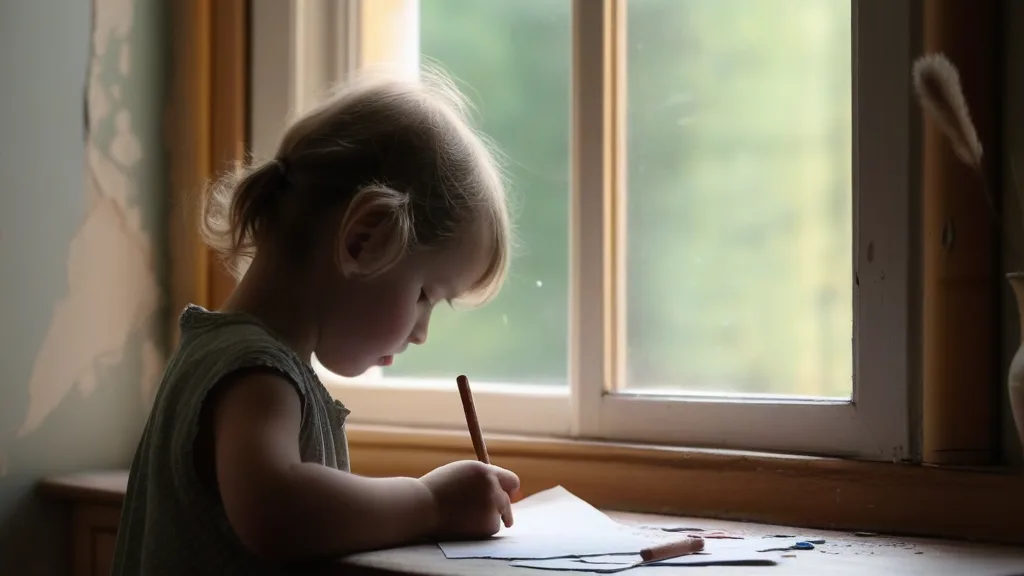
The fifth attempt at drawing a circle. The crayon flies across the room, your child yells “this game/drawing is stupid, I can’t do it,” tears, maybe a kick at the chair leg. You’re standing there with two options in your head: finish it for them so they calm down, or say “come on, one more try, you’re almost there.” Neither option works the way you’d hope — and there’s a reason for that.
What’s actually happening in the moment your child throws the crayons and says “I can’t do it”
In that exact moment, your child isn’t making a decision to quit — their nervous system is overloaded and looking for the fastest way to discharge the tension. Throwing an object, yelling, “this is stupid” — that’s discharge, not strategy.
A now-classic study by Diener and Dweck (1978), on school-age children, found that after a series of failures, some children entered a state the researchers called “helplessness” — they stopped trying different strategies, started talking about themselves negatively (“I’m dumb,” “I can’t do this”), and their performance on the task got worse even after it was made easier again. Other children, despite the exact same failures, kept a “mastery-oriented” stance — treating difficulty as a signal to change strategy, not a verdict. The difference wasn’t ability. It was how the child interpreted the failure — and that’s something a parent’s response has real influence over.
Why helping too fast and pushing too hard both make it worse
The two most common parent reactions in this moment — taking over the task (“give it here, I’ll do it”) and pushing (“come on, one more try, you can do it”) — seem opposite, but they both tell the child the same thing: right now, you’re not able to handle what you’re feeling on your own.
Taking over teaches the child that frustration is a signal for someone else to take the wheel — it works once, but it weakens their belief in their own competence a little more each time. Pushing, meanwhile, ignores exactly what the child has just communicated with their body and voice: that they’ve crossed their current threshold. Pressure usually produces escalation, not “one more try.”
What to say to a child in the moment they want to give up
The sequence that works best has three steps: name it, lower it, leave the choice.
- Instead of: “Give it here, I’ll do it” → Say: “I can see you’re really frustrated — this isn’t going the way you want.”
- Instead of: “Come on, one more try, you’re almost there” → Say: “We can make this easier — a bigger circle, a thicker crayon — or we can take a break.”
- Instead of asking “why are you giving up?” (sounds like an accusation) → Say: “Do you want to try a different way, or come back to it in a bit?”
- When your child is genuinely stuck and a break isn’t helping → help partway, leaving the last step to them: “I’ll do the first part, and you finish it” — that’s different from doing the whole thing for them.
Tone of voice matters more than word choice here. A calm, quiet voice lowers the tension; a raised tone — even with good intentions (“you can do it!”) — often raises it instead.
How to build frustration tolerance long-term — without a program and without pressure
Perseverance isn’t built in one successful moment — it’s built through a repeated experience that frustration isn’t a threat: you can stop, you can come back, and no one judges you for finding something hard. That takes months of consistent response, not one conversation.
A useful model comes from research on “scaffolding” (Wood, Bruner, and Ross, 1976): an adult offers exactly as much support as is needed in the moment — not too little (the child drowns) and not too much (the child learns nothing) — and gradually withdraws it as the child gets better. In practice, that means asking “what do you need right now — a hint, a break, or should we do it together?” instead of automatically deciding for the child.
If you’re looking for everyday small chores that support long-term self-control and patience, we have a separate article on that: End of Tantrums: 3 Everyday Tasks That Build Self-Control. Here we deliberately focus on something else — what to do in the exact moment your child has already thrown the crayons, not on building habits months out.
Sources
- Diener, C. I., & Dweck, C. S. (1978). “An analysis of learned helplessness: Continuous changes in performance, strategy, and achievement cognitions following failure.” Journal of Personality and Social Psychology, 36(5), 451–462. A study identifying two distinct patterns of children’s response to repeated failure — “helplessness” versus a “mastery-oriented” stance.
- Wood, D., Bruner, J. S., & Ross, G. (1976). “The role of tutoring in problem solving.” Journal of Child Psychology and Psychiatry, 17(2), 89–100. The foundational paper introducing “scaffolding” — calibrating adult support to a child’s current need.
Your child isn’t “giving up” because they’re lazy — in that moment, they’ve simply crossed their current frustration threshold. At Dzieckologia we write about school-age emotions without judgment and without one-size-fits-all fixes. Check out the School-Age Emotions (4-10) pillar for more concrete situations from this age.
Author
Dzieckologia Team
Tags:
Like this topic?
📖 Browse all "schoolage" articles